Pain Assessment App

A student at the University of Greenwich has developed an app for iPhone and Android phones, in addition to a web application on the internet, to help assess the level of pain being experienced by someone unable to communicate.

The app which uses the Abbey pain scale, takes the user through a series of questions, for which the user selects the most appropriate answer from a set of answers displayed on the device screen. The flow of the questions varies according to the answer to questions provided at each stage. As the application completes each question, a pain profile is being built in the background. If the user is unsure how to answer a question then additional guidance is provided at each stage. At the end of the assessment the application provides feedback to the user on the steps they should take next.

This is a link to the online version of the app: http://cms1.gre.ac.uk/gwizards/pain-app/

free hd porn

Why use pictures?

“Of all of our inventions for mass communication, pictures still speak the most universally understood language.” said Walt Disney.

Well, he would say that wouldn’t he. But the point he’s making is a serious one, and that was what I was rather clumsily trying to explain to a care home manager recently, when she asked why we bothered with the symbols on our charts. Of course, anyone can stick a white board on the wall and write up the information a carer needs. But are they really going to scan through everything to find the bit that would help them at that moment?

I used to work in print and marketing in a previous career and I was taught many years ago that we have lazy eyes. We need continual stimulation to make the effort to keep reading. That’s why even the most exciting page-turner needs paragraphs. And how many times have you taken a quick look at what promises to be an interesting magazine article only to decide you just don’t have time to plough through it? A different typeface or layout might have given you the encouragement you needed… perhaps a picture to break up the text.

In using symbols on our care charts, not only are we making it quicker for carers to find a specific piece of information they need about an individual, but we’re encouraging them to read on. Perhaps they’ll find some information that provides an opportunity for a conversation with the resident, maybe it will prompt them to update an entry so as to inform other carers. And underpinning it all is the reminder that each individual has a unique set of needs that a carer needs to know about if they are to offer dignified and person-centred care.

The principles are the same for our Because-I-Care Daily Prompt Posters. Would the words have the same effect by themselves? After all, the images we’ve chosen aren’t exactly informative. But they are eye-catching, fun and memorable. They drive home the message that the words impart.

If you think there are other symbols we should include on the charts please let us know, either by leaving a comment below or by emailing feedback@carechartsuk.co.uk


free hd porn

Shouldn’t we celebrate the uniqueness of each individual?

I was troubled by a comment a manager made recently during a telephone conversation we were having to decide on which charts would work best in her environment. She was rightly proud of the extensive refurbishment the home had undergone, but I don’t think she was any more comfortable than I was by the instruction from the owners that nothing was to be put up on the newly painted walls. It’s not really an issue for our charts because we have sizes suitable for the wardrobe door or similar, but I thought how sad it was that residents, or families on their behalf, were not allowed free rein (within reason of course) to reflect their personality, their lifestyle, their individuality in the one place they can call home. They are, after all, paying for that space one way or another. I wonder whether this might be a policy that backfires anyway. The owners want their home to look beautiful, but might prospective clients not see the inability to personalise the rooms as a negative point?

What do you think? Are there valid reasons for keeping a tight control on what can go on the walls of a resident’s bedroom?

free porn sites

Making Involvement Count

This is a great resource for anyone needing guidance or to assess how well they are doing in involving people living with dementia.

These resource cards have been written by people living with dementia, carers, volunteers, staff and Local Involvement Networks (LINks) HealthWatch. Their aim is to strengthen and directly involve people with dementia as well as their families and carers.

The focus of these cards is to provide tools and techniques for staff to facilitate and support people to express their preferences, get involved in activities whilst recognising their current abilities.

Link to Making Involvement Count via the Dementia Partnerships website.

Visit us at the Birmingham Care Show

Having been a visitor to this fabulous show for the past 3 years, I’m very pleased to say we have decided the time is right for us to take a stand ourselves.  You’ll find us on Stand D95 directly opposite the Dementia Care Seminar Theatre and if you haven’t already seen our charts and posters, here’s your chance to see what we’re about. We’ll have samples of the entire range for you to assess, and if you’re already using our products, I really hope you’ll come along and say hello. All visitors to the stand will have a chance to win one of 5 £20 vouchers, redeemable against any of our products – you choose.

Venue: NEC Birmingham. Date: 12th and 13th November 2013. Stand D95

Here’s a link to take you to the Exhibition website where you can find out who else is exhibiting and register for a visitor’s badge: http://www.careshow.co.uk/birmingham/


Is it time to turn our back on paper?

paperless cartoon snipMy experience of computers stretches back to the days when we expected desktop computers to radically reduce the amount of paper we use, yet here we are, printing on to more of the stuff than ever before – we’re using literally tons more paper than we did in the early 80s.

So technology hasn’t done away with paper yet, but there’s a suggestion that the new generation of handheld computers might finally do it. And it might for some tasks, but we should get used to the idea that there are some jobs for which paper is still the best option and stop considering it the ‘old fashioned’ alternative. They’re both tools, and each has its place.

I couldn’t stand the idea of going back to a paper-based address book, for example, but if I want to share information with people, some of whom may not have access to a computer, I’m very happy to pin a notice on the board, stick a scribbled note on someone’s desk or print a list to hand out. And because I don’t want to give everyone unlimited access to my computer I’ll print out the information I want to share, and keep the rest private.

And perhaps that’s the point… at the risk of simplifying things a bit too much, computers create barriers whereas paper breaks them down. If we try to narrow everything down so that all the information we need is available on a handheld for example, we immediately create a distinction between those who have access to information and those who do not. And here I’m thinking of our Care Charts of course. The needs and preferences of an individual should be instantly available to any visitor where that knowledge will make a difference to the care provided: doctors, cleaners, kitchen staff, agency staff, bank carers etc. Even in the unlikely event that you could place a handheld into the hand of each of these people, you have still left behind the family members and friends who might like to use the chart to leave a message or update some information, and how about the resident themselves? We know of many care homes who involve residents in the completion and updating of their charts. It’s another opportunity for interaction and communication with the individual – and that would be lost if everything a carer needs to know is uploaded to a handheld.

The latest technology can make light of many tasks, including the updating and storing of care plans and medical records. Indeed, we have ideas in development that make use of computer technology ourselves. But in attempting to apply technology to every task we risk losing the benefits of the paper alternative: the opportunity to share information, encourage discussion and create opportunities for communication.

Go back to Latest News        Go to Products

More than just a wall chart…

If anything remotely similar to our charts had existed three years ago, I’d have found it. I scoured the internet and the high street to find something that could provide me with the reassurance that my husband’s carers would be reliably informed and kept up to date about his needs and preferences. It seemed such a no-brainer to me that he deserved this effort to get the details right; there was very little opportunity to give him any quality of life at all, and the least I could do was empower the carers to make his life as comfortable as possible. Guilt played its part of course, it always does with us family carers who finally have to admit that we can’t cope by ourselves.

The care home had generated a care plan for him of course. But all I could see was a sheaf of papers in a file that was supposed to be read and digested by a large group of busy people, some of whom did not have English as their first language.

I was offered whiteboards, note books and computer programmes, but none of them was as effective as the scribbled notes I started sticking to his bedroom wall out of desperation. I started using symbols to catch the carers’ eye and allow them to find the information they needed quickly and easily, and then introduced a wipe-clean surface because when things changed I wanted it to be easy to update the information, sometimes on a daily basis.

When the care home approached me to produce more wall charts for their other residents, I introduced one further element: prompts to help carers and family members provide relevant information. I knew how difficult I had found it when presented with the request for information about Geoff. It had taken me a number of weeks to bring to mind things I hadn’t initially thought about which could make a difference to the quality of his care.

I was a daily visitor to that care home for 13 months. During that time I saw how giving carers information about the individuals they were caring for worked at a level so much more profound than just ensuring they put the correct amount of sugar in their tea. It reminded them that these were people who had families, interests, careers, had travelled, loved, lost, had happy and sad memories, just like those of us lucky enough not to have to live in a care home. I am painfully aware that ‘person-centred care’ has become a cliche too casually bandied about, but if used well, these charts can facilitate person-centred care in the manner Tom Kitwood envisaged so many years ago, exhorting carers to: “treat others in a way you yourself would like to be treated”.

It’s our third birthday

To celebrate our third birthday and for this month only, we’re offering a full 10% discount on all orders placed in July. Please use the Promotional Code ‘July’ when placing your order (click here to see the full range), or be sure to mention it if you prefer to phone us with your order, on 01403 210485.

Remember-I’m-Me Care Charts have been changing lives for 3 years now, and they are more important than ever, with care home managers having to meet ever-increasing expectations from budgets that are being squeezed so hard each pound has to pull its weight (if you’ll excuse the appalling pun). So a product that can make a tangible difference to the quality of life of carers as well as those they care for, for just a few pounds a resident, has got to be worthy of serious consideration. Go to our Online Shop to see the full range.

Make sure all your staff are ‘on board’

One afternoon, whilst I was visiting my husband in the care home in which he spent the final 13 months of his life, a girl I hadn’t seen before pushed the tea trolley into his room, and asked me how Geoff took his tea. He’d been there a while so I was fairly sure she was new. “The chart on the wall says how he likes his tea,” I point out to her. “Oh yes!”, she says, “I didn’t see that!” She had been working her way down the corridor, so I knew she must have been into at least 6 rooms prior to Geoff’s, and each one of them had a Care Chart clearly visible once you were in the room. She’d have seen them eventually, but had they been mentioned in her training, the home would have had an employee better able to do her job from day one.

The story has a happy ending. A few days later I saw her again, and she was bubbling with enthusiasm. “I’ve been able to have all sorts of conversations when I go round with the tea trolley,” she explained, “because I can ask the residents about the members of their family that are on the chart, and talk about their hobbies, or even just comment on their favourite food or TV programme. Without the chart, it would be difficult to think of something to say.”

I couldn’t have put it better myself!

It’s exhibition season

It feels like I’ve spent more time at exhibitions than in the office recently, and there have been more I could have attended if time allowed. They range from the huge events at London’s Excel, with hundreds of exhibitors, thousands of delegates and dozens of speakers, to the more intimate Nottingham and Derbyshire Care Conference at Nottingham’s Belfry Hotel, where we dipped our toe in the water and exhibited for the first time. This was a much more modest event, just 30 exhibitors, but there was still an excellent line-up of speakers and, judging by the discussions with visitors to our stand, a highly motivated and enthused group of 100 or so delegates.

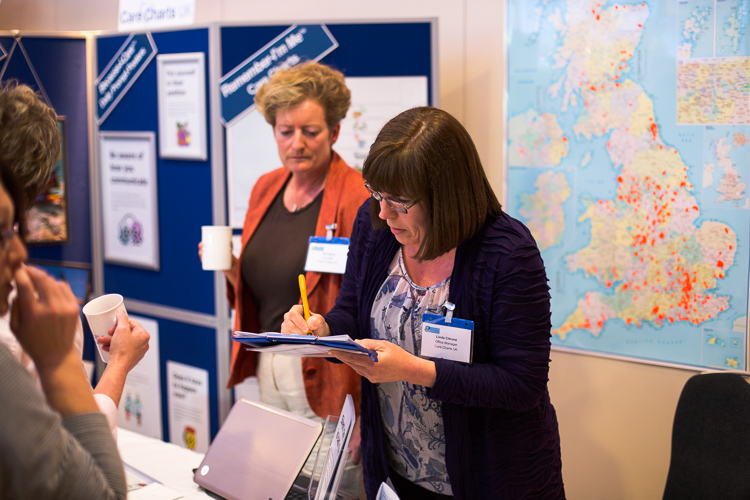
(The map on the wall in the picture shows where our products are now being used… over 600 care homes in virtually every county in the UK. That’s Linda taking an order by the way, and I’m the one drinking coffee – as per.)

It was great to meet care home managers and owners who are already using the charts, and even more gratifying to hear their words of praise, like these from Simon Hodgkinson, owner of Westcliffe Care Home in Nottingham…

“We have been using the care charts at Westcliffe Care Home for approximately 8 months. We believe they make a real difference to the quality of life our residents lead; because it means we get the things that matter to them right – particularly the small things that really make a significant difference. We do not often have agency staff but when we do they all comment on how useful the charts are. The charts get them up to speed very quickly which means they can deliver quality, individualised care immediately – and of course they have gone down very well indeed during inspections!”

Notts 13 Linda takes an order